Project Snapshots
My research focuses on developing new ways to manage noisy processes, using tools from control theory, risk analysis, and optimization. I am particularly interested in accounting for unexpected possible outcomes. My work in control theory has applications to many risk-prone areas, including stormwater management, cancer treatment, and robotics. Snapshots of some projects follow.
Risk-Aware, Multi-Agent Systems (with D. Patel)
Systems consisting of collaborating agents can be found in different application areas, from networks of microgrids to search-and-rescue robot teams. This motivates the mathematical study of cooperative control problems. These problems aim to determine how agents can successfully collaborate despite challenges like limited communication and uncertainty. Instead of merely reducing an uncertain outcome to a simple average, however, we developed a principled, risk-aware approach to optimal cooperative control (preprint). Our approach equips agents with awareness of variability in the uncertain outcome, in addition to its expectation. Our approach also rigorously relates a multi-agent formulation to a standard formulation and vice versa, further distinguishing it from previous work. A key ingredient in our approach is a family of block-diagonal-like matrices, which enjoy many convenient mathematical properties. Dhairya Patel developed this contribution as an MASc student and is now a PhD student in the DATA Lab. We gratefully acknowledge Funding Sources 1 and 2 (see list below) for supporting this research.
 |
Data-Driven Risk Estimation (with E. Arsenault, Y. Wang)
 |
The modern age is known for “big data.” However, the data that is available and appropriate for a particular task at hand may be sparse. This motivates the problem of estimating rare behaviour of a noisy process when only a small dataset is available. We developed a new approach to this problem by combining ideas from extreme value theory and financial risk analysis. Extreme value theory is a statistical theory concerned with the distributions of long-term maxima of random variables (see de Haan and Ferreira, Extreme Value Theory, Springer, 2006 for an excellent introduction). We applied this theory to estimate the rare behaviour of a noisy process, and demonstrated that our approach outperforms standard estimation when data is sparse. We also applied our approach to a real dataset of combined sewer overflows, a major environmental challenge in Canada and abroad. To learn more about this work, please see the preprint. We gratefully acknowledge Funding Sources 1, 2, and 3 (see list below) for supporting this research. For other works with Evan Arsenault and Yuheng Wang, please see Error analysis for approximate CVaR-optimal control and Risk-averse autonomous systems: A brief history, respectively. |
Tractable, Nonlinear Risk-Aware Control (with D. Patel)
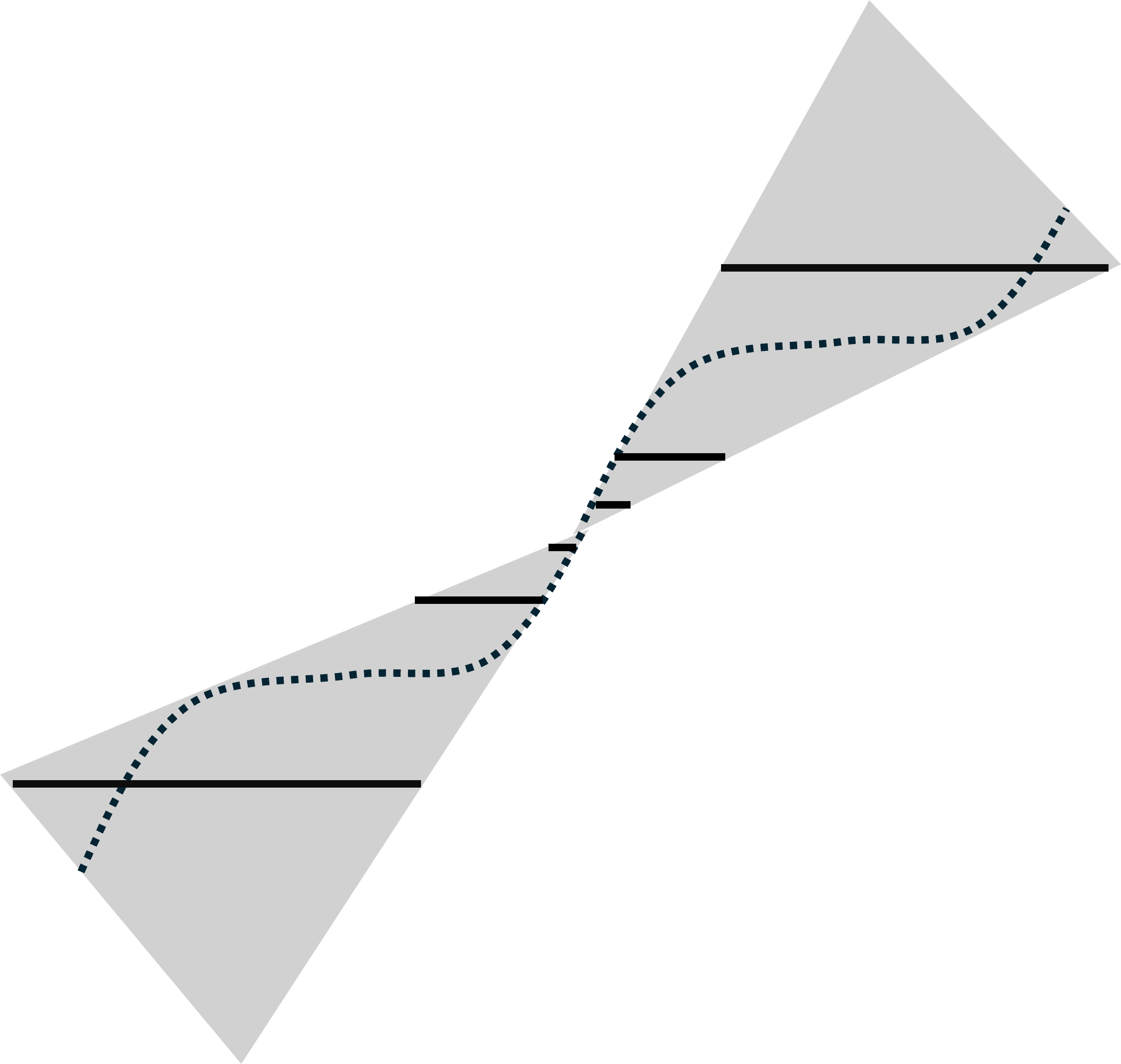 |
Consider the rise and fall of stock prices, robots navigating uneven terrain, and energy generated by a wind farm. These different systems share a key feature: their behaviour is inherently uncertain. While many classical control methods reduce uncertainty to a simple average or a worst-case outcome, risk-aware control aims to equip systems with a refined awareness of uncertainty. However, there is a paucity of tools for tractable, risk-aware control of nonlinear systems. To help close this gap, we developed an analytical, risk-aware controller for systems with nonlinearities satisfying cone-like bounds. We were inspired by earlier work involving systems with cone-bounded nonlinearities. Examples of these nonlinearities include saturations and quantizers. We evaluated the viability of our approach on a high-dimensional system (state space R^1000, action space R^100) using a simple script on a laptop. For general nonlinear systems, a numerical dynamic programming approach to controller design would be unviable for a stochastic system of this size. To learn more about how we enable tractable, risk-aware control for a class of nonlinear systems, please see the preprint. We gratefully acknowledge Funding Sources 1 and 2 (see list below) for supporting this research. |
Risk-Aware Stability Theory (with D. Kalogerias)
Stability theory is an elegant mathematical theory that concerns the long-term behaviour of dynamical systems. Many flavours of stability theory have been developed over the years, including analysis of how noise affects the state in the long run, i.e., “noise-to-state” stability. However, classical analysis oversimplifies the effects of uncertainty by relying on standard averages. Instead, we develop a generalized approach that can highlight different features of probability distributions, rather than just the average. This work pushes the envelope in dynamical systems analysis by taking a new, risk-aware look at a classical theory (initial preprint; please see Chapman and Kalogerias, IEEE Trans. Autom. Control, 2025 for the final version). I gratefully acknowledge Funding Sources 1 and 2 (see list below).
Modelling and Control for Leukemia Treatment (with K.F. Li, C. Wei, T. Suzuki, S.M. Chan)
 |
Risk mitigation is crucial in many applications, including medicine. We are working to develop new chemotherapy dosing strategies for the treatment of leukemia, a type of blood cancer. A standard, nominal dosing strategy is to adjust the dose by a fixed percentage according to the patient's neutrophil concentration. While this rule-based strategy is convenient and intuitive, it is often far from optimal, unfortunately leading to underdosing or overdosing. Instead, we aim to bring together control theory and patient data to develop new dosing strategies that rigorously consider individual patient dynamics. This research may set the stage for a new decision support tool to help clinicians enhance leukemia treatment. We gratefully acknowledge Funding Sources 1 and 4 (see list below) for supporting this research. |
Funding Acknowledgements
We acknowledge the support of the Edward S. Rogers Sr. Department of Electrical and Computer Engineering at the University of Toronto.
We acknowledge the support of the Natural Sciences and Engineering Research Council of Canada (NSERC), [funding reference number RGPIN-2022-04140]. Cette recherche a été financée par le Conseil de recherches en sciences naturelles et en génie du Canada (CRSNG), [numéro de référence RGPIN-2022-04140].
We acknowledge the support of the Natural Sciences and Engineering Research Council of Canada (NSERC), [funding reference number DGECR-2022-00098]. Cette recherche a été financée par le Conseil de recherches en sciences naturelles et en génie du Canada (CRSNG), [numéro de référence DGECR-2022-00098].
We acknowledge the support of the Data Sciences Institute at the University of Toronto for Modelling and Control for Leukemia Treatment, [grant number DSI-CGY4R1P26].
 |
 |
 |